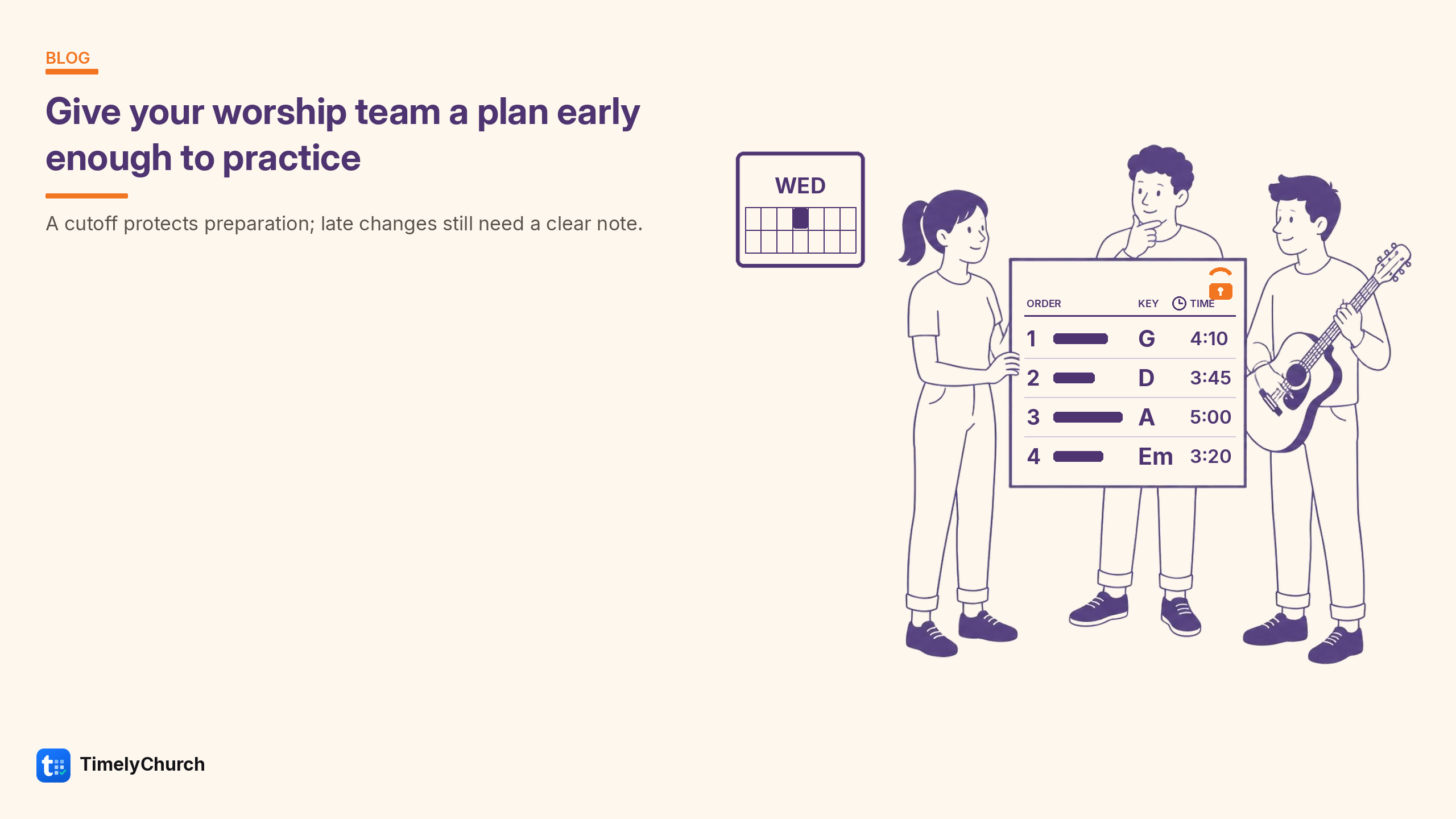
A small band has little spare rehearsal time to absorb a changed key, an added song, or an unexpected extra bridge. Settle the decisions people need for practice while there is still time to use them.
A guitarist may have found one practice window on Tuesday. A singer may have learned the melody during a commute. When the plan changes on Saturday, that preparation has a cost even if the new version takes only a minute for the leader to edit.
Choose a point in the week when keys and order become the working plan. Necessary changes can still happen, but someone needs to explain their impact and make sure the people affected have a workable response.
Check the key with the singer
Sing the highest and lowest phrases, not only the opening line. Confirm the sounding key with the instrumentalist and document any capo shapes separately.
Do this before distributing the set. A recording’s original key may suit its artist while being uncomfortable for your lead singer or congregation. Discovering that the final chorus sits too high on Monday gives you choices; discovering it during sound check gives everyone another hurried task.
Time the arrangement you will perform
A recording’s duration is only a starting estimate. Your intro, spoken transition, repeated chorus, and ending all affect the service slot.
For an illustrative 20-minute slot, four four-minute songs already use 16 minutes. Three one-minute transitions leave one minute of margin. An added two-minute response would exceed the slot. Work through the arithmetic before deciding the set fits.
TimelyChurch’s setlist duration summary can help you notice a mismatch, but it relies on stored song information. Missing durations and different live arrangements make it approximate. Time a run-through when timing matters.
Make the order musical and practical
Consider the congregation’s participation, vocal effort, instrument changes, and who starts each song. A sequence that looks good on a list may create an awkward equipment change on stage.
Practice at least the transition into each song. Include any silence or spoken introduction in the plan rather than treating it as time that happens outside the set.
Make room for necessary changes without making every decision provisional
A cutoff is a coordination habit; the software will still let you edit after it. Once it has passed, ask what a change affects and who needs to know.
In TimelyChurch, the setlist holds the selected arrangements, target keys, and notes. Publish chart corrections and notify the team deliberately. If a Service Plan or exported presentation already exists, check those too; they should not be assumed to update every copied detail automatically.
If you want to see where setlists live in TimelyChurch, the Worship Module walkthrough covers the song library, setlists and My Stand.

For a late change, send the specific difference: “Song three moves to D; order and ending stay the same.” Confirm printed charts and playback where relevant.
At the next rehearsal, ask whether people received stable information soon enough. The purpose of the cutoff is to protect preparation while leaving room for responsible leadership.
TimelyChurch’s setlists give those arrangements, keys, and notes a shared place to live. Set up a real week in TimelyChurch with a singer’s key choice and a service-time limit. Ask whether the set became clear early enough for your volunteers to prepare from it.