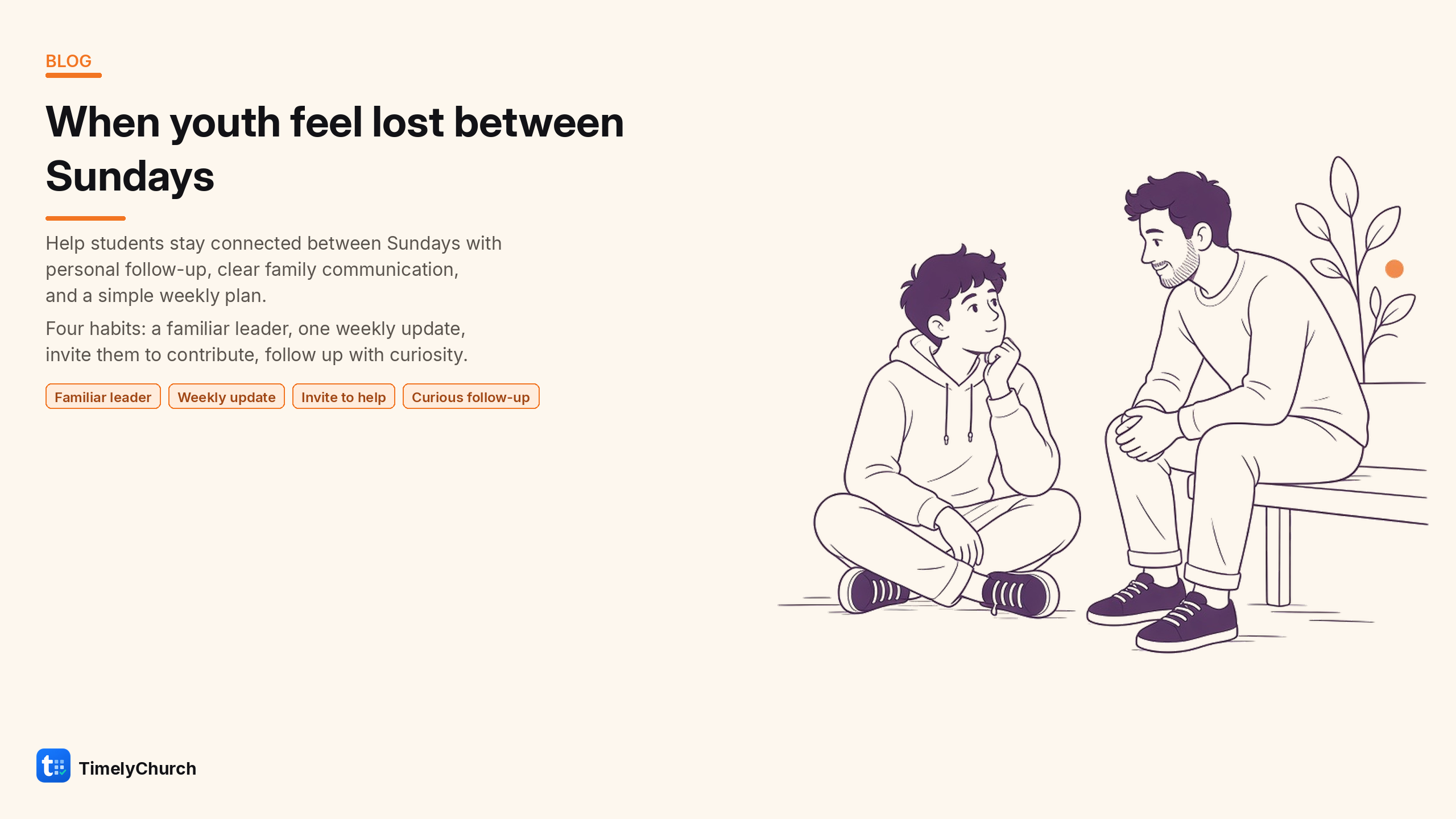
Picture a student who joins the conversation on Sunday but leaves unsure about the week ahead. When is youth night? Will someone welcome them at the door? Did anyone remember the difficult week they mentioned?
For a youth pastor or volunteer leader, those questions sit alongside lesson preparation, work, family, and the search for someone to bring snacks. Care is there. Time and attention are stretched.
Helping young people stay connected takes both relationships and reliable follow-through. A clear plan can remove practical barriers and give leaders more room to listen, pray, and walk alongside students. Here are four habits a small church can put into practice this week.
1. Make sure each student has a familiar leader
Start with a question for your team: Who knows how this student is doing?
Look through the youth group list together. Include newcomers and students who have been away. Agree on which leader will welcome each student, learn their interests, and follow up on conversations. Keep those connections consistent where you can, with another leader able to help when someone is away.
The next conversation can be simple: “How did your first week at the new school go?” or “Is there something you would like us to pray about?” Leave room for a short answer, a longer conversation, or no answer yet.
Use church-approved communication channels and follow your church’s policy for involving parents or guardians. Consistent care should be something the ministry team can support together.
Try this week: identify one student whose week nobody on the team knows much about. Decide who will make space to listen at the next gathering.
2. Give students and families one clear weekly update
A family should be able to find the essentials without searching through a week of messages. Choose a predictable day for the update and a channel families already use.
Include the date, start and end times, location, pickup arrangements, what to bring, and the leader to contact. Say briefly what students can expect, especially if someone is coming for the first time.
Here is a message you can adapt:
Youth night is Wednesday, September 16, from 6:30–8:00 p.m. in the church hall. We’ll have snacks, a game, and a conversation about prayer when school feels overwhelming. Bring a Bible if you have one; we’ll have extras. Meet us at the hall entrance, with pickup at the same door at 8:00. Please contact [leader] through [church contact channel] with questions or to discuss transport needs. First time coming? Let us know so we can welcome you at the door.
Keep the current details in one place your leaders can update. If your church has a public events page, include its link in the weekly message so families can check the plan later and share it with a friend. If plans change, update the event and send the correction through the same communication channel. Offer a printed reminder or phone call for families who need it.
Try this week: ask a parent who missed Sunday to read the update. Check whether they can tell when to arrive, where to go, and whom to contact.
3. Invite students to contribute in ways that fit them
A student might enjoy choosing a game, helping with music, setting out snacks, or reading a passage with a leader. Ask what interests them, offer a specific role, and explain who will help them do it.
“Would you like to help Jordan set up the game for ten minutes?” is easier to respond to than “We need everyone to get involved.” Give them room to decline or try something different.
Make it clear that students belong whether or not they take a role. Keep adult responsibilities with the adults, and make time for students to receive care and join the gathering themselves.
Connection also includes space for their questions. During the week, offer one optional prompt that carries Sunday’s discussion into everyday life: “Where could you put what we talked about into practice at school?” Pick it up again when you meet, without making participation feel like homework.
Try this week: offer two small ways to contribute and invite students to suggest another.
4. Follow up with curiosity when someone is away
A missed gathering tells you that a student was absent. It does not tell you why. Schoolwork, transport, family schedules, or a difficult experience in the group may be part of the story.
Agree on who will follow up through your church’s usual communication process. Keep the invitation warm and leave room for the family’s circumstances:
We missed seeing you this week and hope you’re doing okay. You’re welcome at the next youth night. Is there anything that would make it easier for you to join us?
When they return, welcome them naturally. Avoid making them explain their absence in front of the group. Listen if they raise a concern, and follow through on any help you offer.
Give that care a clear next step: who will make contact, by when, and what happens afterward. For example, a leader might agree to call a parent on Tuesday about transport for Wednesday. Record whether contact happened and any action still needed, so the next leader can follow through on the promise.
Try this week: set aside ten minutes after youth night for leaders to agree on follow-up and next week’s preparation. Give each action a named owner so it does not depend on one person remembering everything.
Where TimelyChurch can help your team follow through
These habits can start with a shared document and a reliable routine. When keeping people, care commitments, and event plans up to date becomes extra work, TimelyChurch gives your team a way to manage them within the church’s wider system.
For the week around one youth night, start with these pieces:
- People and families: keep student and household records together, and organize the youth group through a group or class. Review who needs access to contact information.
- Follow-ups: create a follow-up linked to a student or parent, assign it to a leader, and set a due date. Use it to welcome a newcomer, check in after an absence, or follow through on an offer of help. The assigned leader can see it in My Tasks with portal access. Track its status and add a brief completion note so your team knows what happened and can arrange the next step.
- Events and your church website: create the gathering with its date, time, and location. If your church chooses to use TimelyChurch’s Website Studio, the website’s Events section automatically pulls upcoming public events from those same records. Changes to event details carry through to the website, saving leaders from entering the same information twice. Families can check public event details without a portal login. See Grace Church’s website and its events page for an example, including youth gatherings.
- Serving assignments: schedule volunteers for the event. Volunteers with portal access can use My Schedule to see their assignments and who else is serving at those events. This roster covers serving roles; it does not tell you which students plan to attend.
- Prep Tasks: add jobs such as buying snacks, preparing the discussion, and unlocking the room. Give each task an owner and due date. Assignees with portal access can find their jobs in My Tasks.
Leaders can manage the plan while students and families receive the information through the agreed communication channel. Students do not need a login to be welcomed or included.
The benefit is practical: your team can see who is responsible for reaching out, which care commitments remain open, and what needs preparing. A connected church website gives families a consistent place to find upcoming events. Your leaders still provide the listening, prayer, teaching, and personal follow-through that give those plans meaning.
Start with one week
Before adding another activity, agree on three things: who will welcome and follow up with students, when families will receive the update, and who owns the preparation.
After the next gathering, ask students what helped them feel included and what was confusing. Ask leaders whether the plan left them time to be present. Use those answers to choose the next improvement.
If your team would benefit from organizing this work in TimelyChurch, the free plan supports up to 100 people, basic groups and classes, and events. Follow-ups, volunteer scheduling, the member portal, and Website Studio are available on Growth and Pro; compare the plans for website limits, custom-domain options, and the features your team needs.