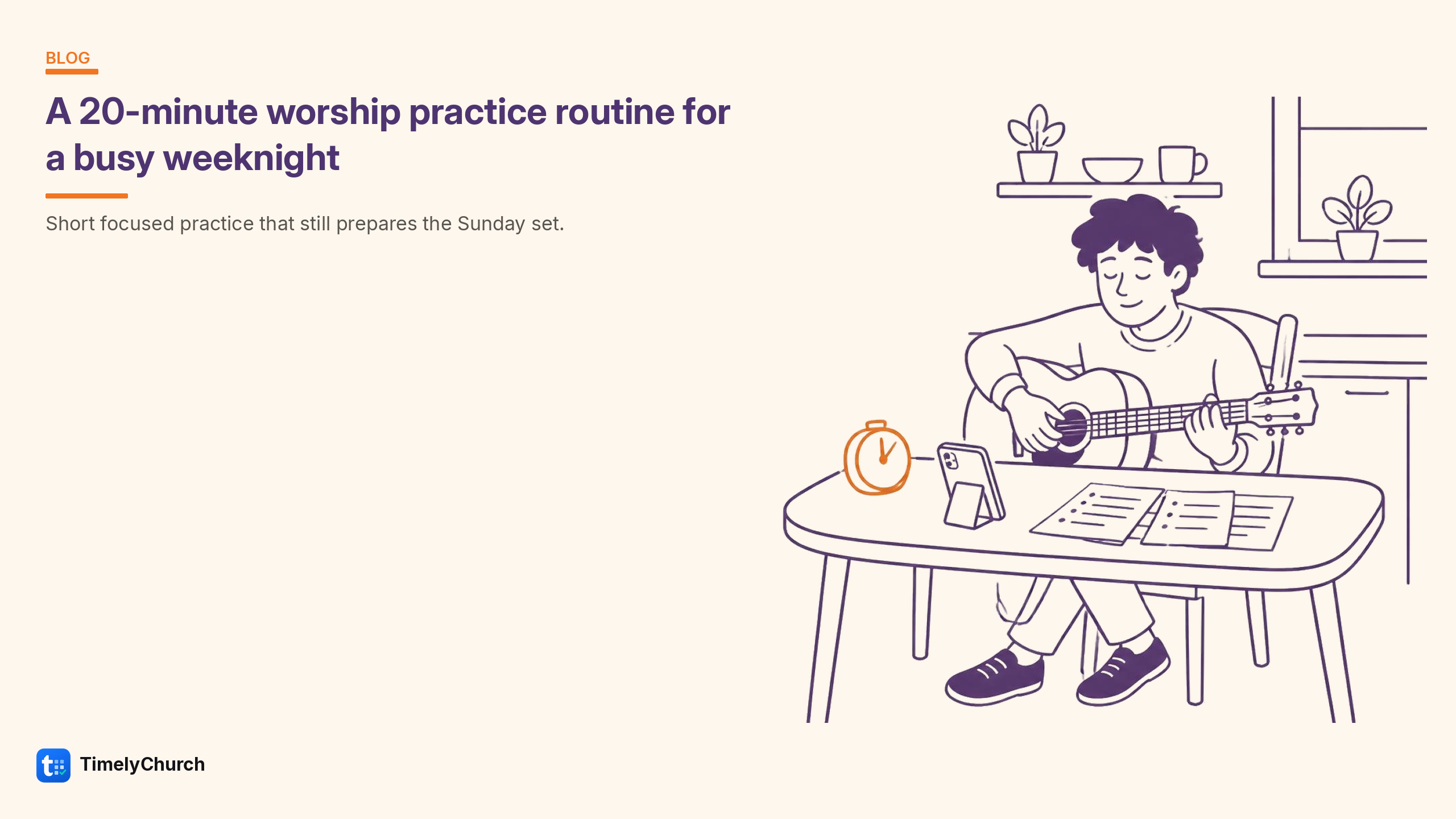
You have twenty minutes before the next household job needs doing. It is tempting to spend them playing the song you already enjoy, then hope rehearsal will sort out the unfamiliar bridge.
A short practice session can do more when you choose one specific problem at the start. You don't need to perfect the whole set tonight. Aim to understand the current arrangement, improve the least comfortable transition, and know what to ask the leader.
Use the timing below as a guide. A difficult passage may need more time; an easy one may free you to work on something else.
Minutes 1 to 4: Read the plan
Check the song order, sounding keys, arrangement names, and leader's notes. Locate your entrances and any unusual ending. If a chart and recording disagree, write down the question before choosing one silently.
Pick one difficult transition to work on. Examples include the bass entrance after a quiet verse, a harmony that starts halfway through a chorus, or the move from the bridge into the final chorus.
Minutes 5 to 12: Repeat the difficult passage
If the trouble is entering after a quiet verse, don't begin practice on your first note. Begin before it. Listen for the lyric or chord that tells you the entry is coming, then play your part.
Work slowly enough to get that connection right, and gradually return to the intended pace. Repeating only the notes after the entrance can make them familiar without teaching you when to play them.
TimelyChurch's My Stand includes a personal metronome. Where a suitable reference audio file is attached, Rehearse also provides a player with loop points and speed controls. A link to a streaming service is not the same as an attached audio file with those controls.
Check that the reference is the arrangement and key you need. Changing the chart's viewing key doesn't automatically transpose that recording. The personal metronome is a practice aid, not a synchronized click distributed to the band.
This short TimelyChurch University walkthrough shows how to rehearse a set and mark songs learned in My Stand.

Minutes 13 to 17: Play the transitions
Run the end of the previous section into the difficult passage. Then practice the exit. Musicians often know the middle of a chorus but hesitate over how it begins or ends.
Add one precise reminder: “Enter after the second vocal line” is more useful than “Remember bridge.” My Stand supports private marks and notes, with optional sharing when a reminder helps the team.
Minutes 18 to 20: Report the remaining question
Decide whether you are ready to rehearse the song with others. If your team uses Mark learned, update that self-report honestly. It doesn't measure how long you practiced or certify that the part is perfect.
Send a specific question when you need help: “I can play the verse and chorus; could we check the last two bars of the bridge together?” This gives the leader something to plan around.
For a night with only five minutes available, keep the same order: verify the version, work on the highest-risk transition, and communicate the unresolved point.
To keep the set, reference material, and personal reminders close together, open your set in My Stand. Use your next short practice window to try one difficult transition. The useful measure is whether you arrive at rehearsal knowing your part better and able to name the help you still need.