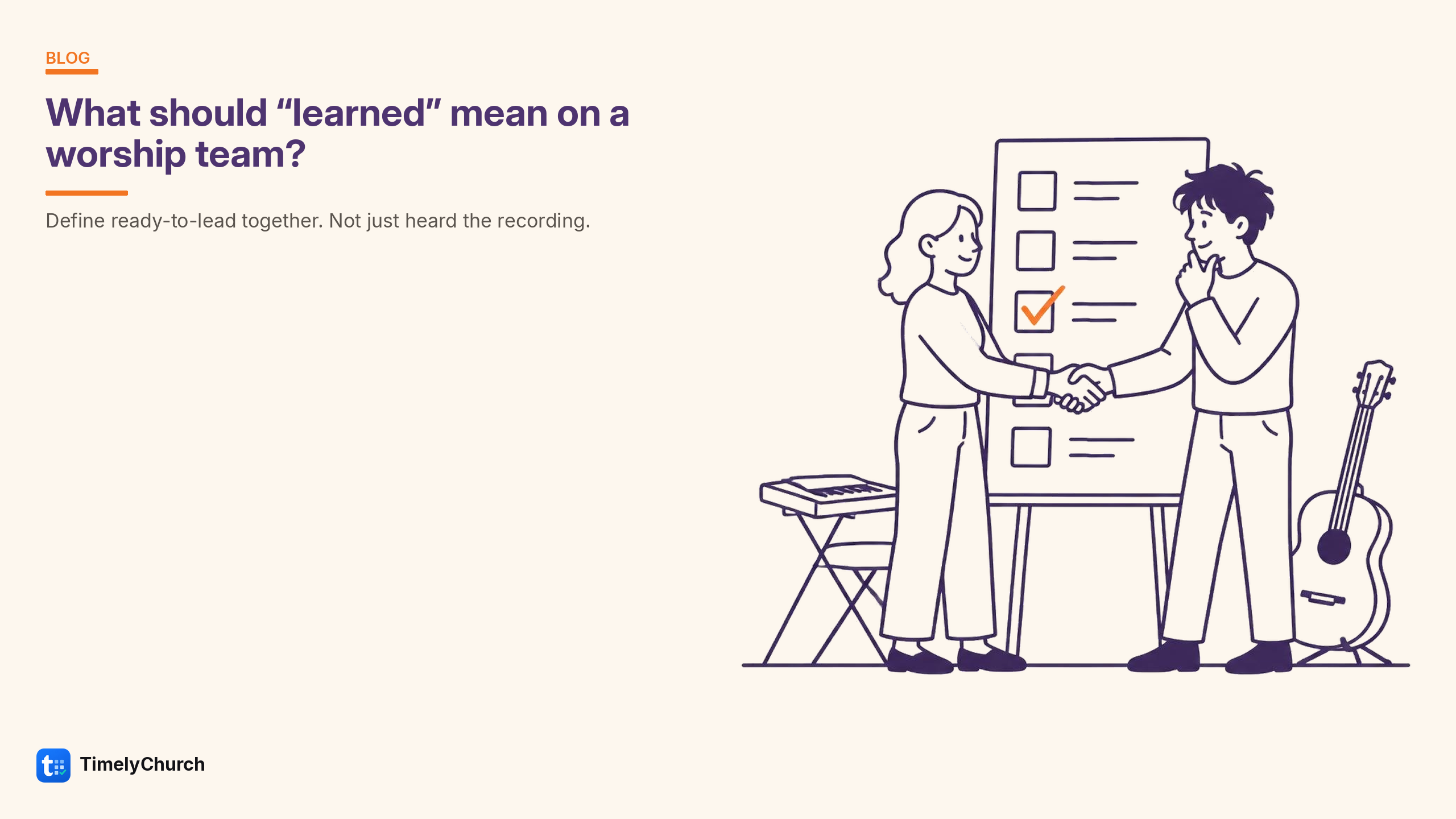
A green check beside a song can mean several things: “I listened once,” “I know the melody,” or “I can play our arrangement at tempo.” If everyone uses a different definition, the leader still has to guess what rehearsal needs to cover.
The checkbox is only useful if a musician can answer it honestly. If “learned” sounds like a claim of perfect performance, careful players may never mark it. If it means only recognizing the title, it tells the leader very little.
Give the team a definition tied to this week’s arrangement and the work you expect before rehearsal.
Define readiness for the role
A starting definition might be: “I can follow my part in the selected key and arrangement, including the entrance and ending, and I know which questions to bring.”
Adapt it to the instrument. A singer checks words, melody, harmony entries, and range. A drummer checks the groove, transitions, and stops. A guitarist checks chord movement, voicing choices, and any capo setup.
A singer might be ready to rehearse while still wanting to settle one harmony entry with the lead. A drummer might know the form but need to hear how long the leader wants to hold the ending. Those are ordinary rehearsal questions and don’t mean the preparation fell short.
Explain where the individual work ends and the shared work begins. That makes the response less intimidating and more informative.
Give people usable material first
Before asking for a learned response, provide the selected arrangement, sounding key, and a reference. Explain differences from the recording. Send the set early enough for the preparation you expect.
If the arrangement changes materially afterward, ask musicians to reassess the affected song. A prior learned mark may describe the version they practiced, not the new one.
Use the signal for planning
In TimelyChurch, musicians can mark songs learned in My Stand’s rehearsal flow. Leaders can see learned counts by song and member alongside rehearsal RSVPs. These are self-reported signals; they are not listening-time measurements or proof someone can perform a part.
The short TimelyChurch University video below shows how to rehearse a set and mark songs learned in My Stand.

Private practice notes remain separate from the leader’s readiness view. Encourage people to keep useful personal notes and communicate any question the leader needs to resolve through the normal team channel.
If most people flag the same song as unfinished, inspect its materials and difficulty. If one person is uncertain, offer targeted help rather than making the whole band repeat another reminder.
Leave room for an honest answer
Try a prompt such as:
Mark the songs you can follow in our arrangement. If one is still uncertain, tell me the section so we can use rehearsal well.
Do not punish someone for reporting the exact uncertainty you asked them to reveal. A falsely reassuring check is less useful than an accurate question.
At rehearsal, compare the reported readiness with the passages that actually need work. Refine the definition together.
With that agreement in place, set up your first week in TimelyChurch. Use the first week’s responses to choose something specific to rehearse, then tell the team how their answers helped.