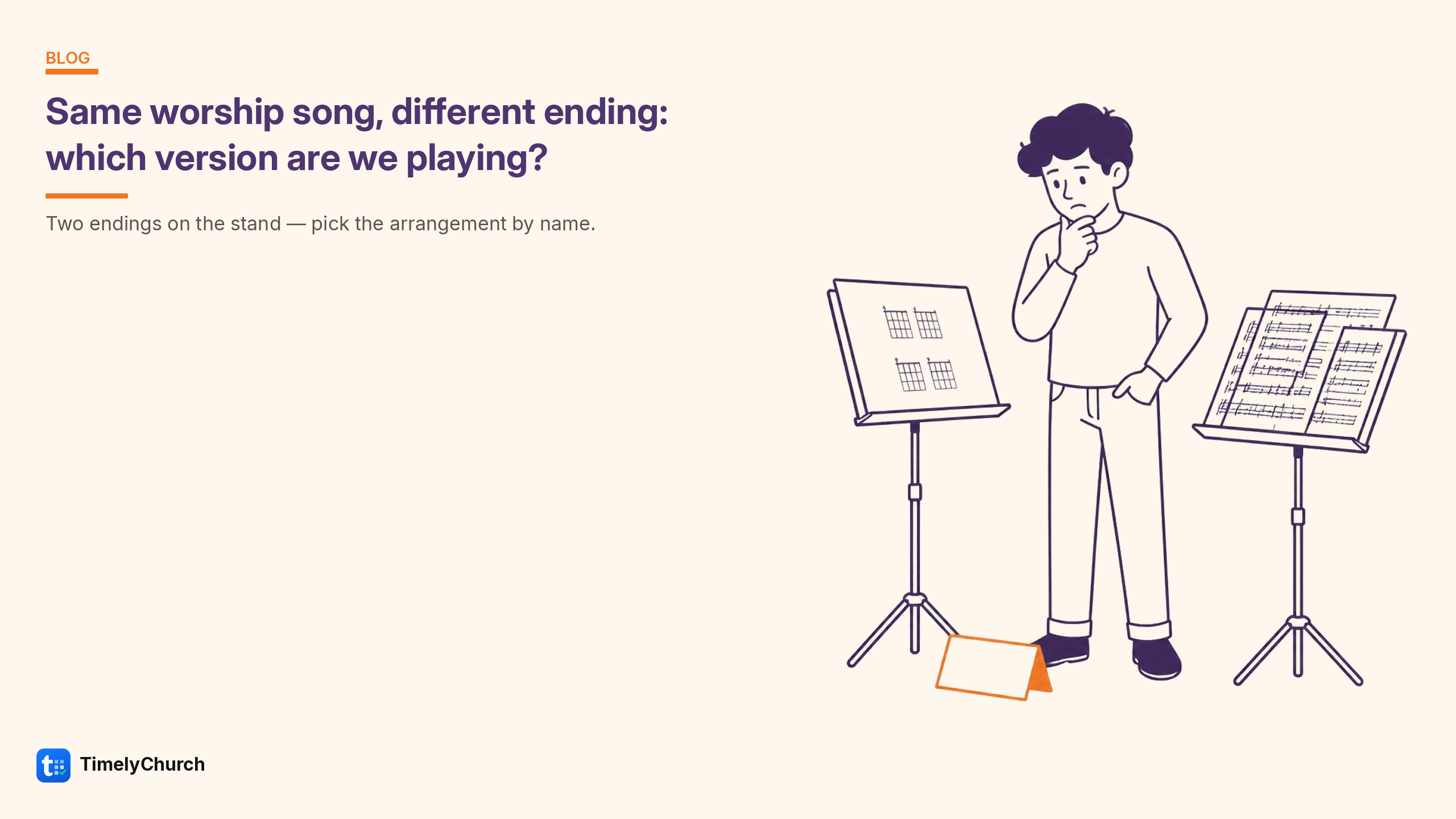
Your regular guitarist knows the acoustic version ends after the second chorus. The substitute drummer learned the recording, complete with a long bridge and a bigger final chorus. Both prepared. Both can reasonably say they learned the song.
The missing information was the arrangement.
A title tells people which song you chose. It does not tell them how this group will play it. Making that distinction clear is one of the simplest ways to make a song library useful to someone who was not there when the decisions were made.
Which differences deserve their own version?
Ask whether a musician would need to relearn part of the form. An acoustic version without a bridge and a full-band version with an extended ending are worth naming separately if you expect to use both again.
A different key usually does not need another song entry. Neither does a guitarist’s capo preference or a player’s choice to read numbers. Those change how someone reads or plays the material, without necessarily changing the arrangement.
This prevents a library from filling with “New,” “Latest,” and “Sunday version,” names that lose their meaning almost immediately.
Name the difference someone needs to notice
“Acoustic — no bridge” is more useful than “Version 2.” “Full band — extended ending” tells the operator exactly where to look for a difference.
Under that name, leave the exception to the reference recording in a short sentence:
Follow the recording through the second chorus. Skip the instrumental solo. Sing the final line twice, then stop together.
For a volunteer with twenty minutes to prepare, that sentence may be more valuable than another attachment. It tells them where copying the recording would lead them wrong.
Check the assignment as well as the chart
It is possible to have two perfectly good charts and still send the wrong material. Before notifying the team, open the setlist and check the selected arrangement and service key.
Ask a musician who was not involved in preparation to describe the ending from what they received. If they need a verbal explanation, add that missing information to the arrangement. You are testing whether the handoff works, not testing the musician.
In TimelyChurch, multiple arrangements sit under one library song. The setlist selects the arrangement and target key, and My Stand uses that selection. Review and publish the chosen chart before sending the team to it. The Sequence strip helps people navigate, but it does not rearrange the chart body or assemble every repeat in the lyric presentation.
Tidy one song before reorganizing the whole library
Choose a frequently used song with several confusing copies. Identify the versions you still use, give them useful names, and check upcoming setlists before retiring anything. Existing links or historical records may still depend on an older entry.
The next substitute should be able to find the form and ending without reconstructing your church’s musical history.
If your library has become a collection of nearly identical titles, add its arrangements in TimelyChurch. Start with that one song and its recurring arrangements. The improvement should be something your next volunteer can understand immediately.